
Global use of natural gas in 2022
Natural Gas Stoves around the world
Summary
| Region | Estimated Number of Natural Gas Stoves | Source/Methodology |
| **United States** | **~47 million** | U.S. Energy Information Administration (EIA) |
| **European Union** | **~78 – 88 million** | Industry reports, household surveys |
| **Global (Rough Estimate)** | **~500 – 700 million** | Calculation based on global households and usage rates |
In conclusion, while we can’t know the exact number, we can confidently say there are hundreds of millions of natural gas stoves in the world, with the most reliable figures showing around 47 million in the U.S. alone.
The percentage of worldwide natural gas production used for cooking is approximately **3.3%**.
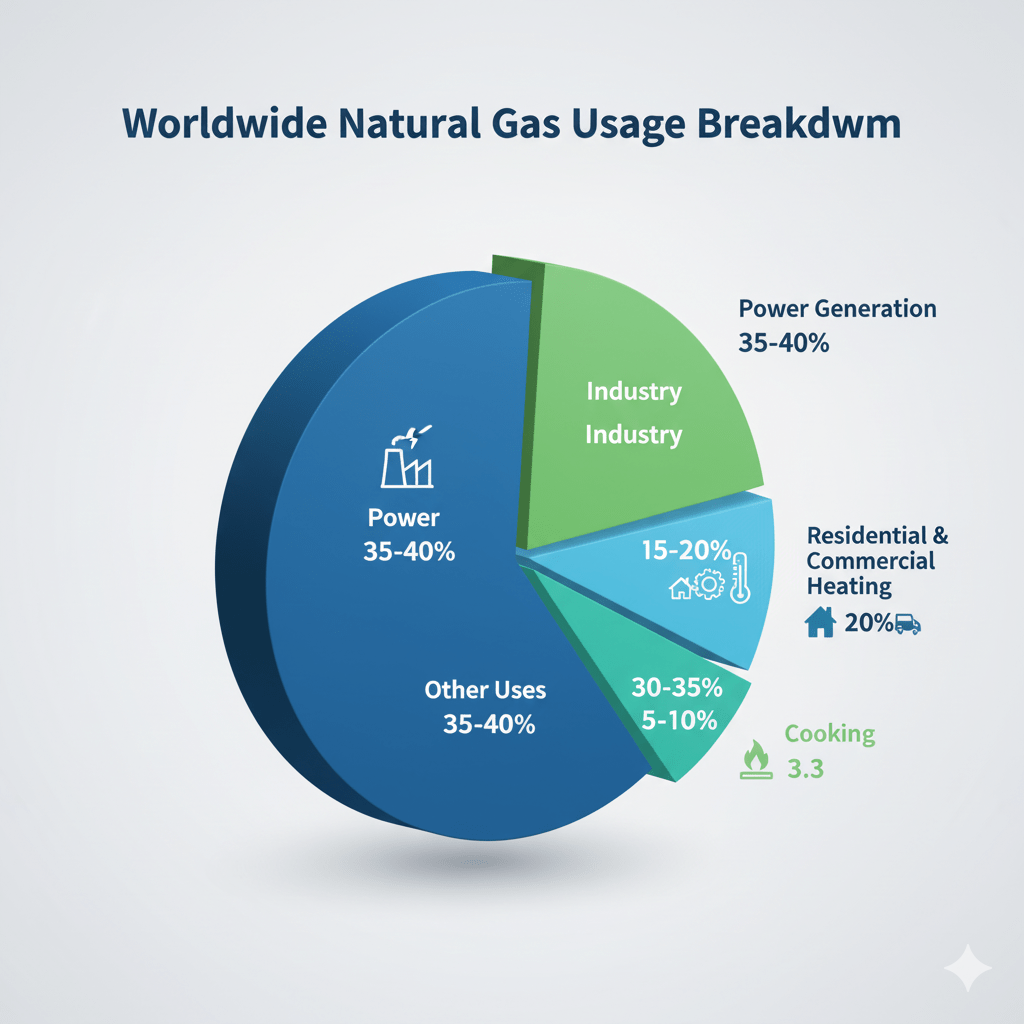
Power Generation (~35-40%): Power plants burn enormous volumes of gas to create electricity.
Industry (~30-35%): Used as a fuel for heat and as a raw material in chemical plants, fertilizer production, and manufacturing.
Residential & Commercial Heating (~15-20%): Heating homes and water, especially in cold climates, is a massive consumer of gas.
Other Uses (~5-10%): Includes transport (CNG vehicles), gas distribution losses, and other energy sectors.
So, while cooking is a very visible and important use of natural gas in our daily lives, on a global scale, it is a relatively small drop in a very large bucket.
it’s impossible to give a single, precise number for how many natural gas stoves exist in the world. The number is constantly changing as new stoves are sold and old ones are discarded.
Best Available Estimates (By Region)
United States
This is the region with the most reliable data. According to the U.S. Energy Information Administration (EIA):
Approximately 47 million households in the U.S. cook with a natural gas stove.
This represents about 38% of all U.S. households.
So, a solid estimate for the U.S. is **around 47 million natural gas stoves**.
European Union
Data for the EU is less centralized but still available. According to various industry and energy reports:
Roughly 40-45% of households in the EU use gas for cooking.
With about 195 million households in the EU, this translates to an estimated 78 to 88 million natural gas stoves.
Other Regions
China: China has a massive number of households, and a significant portion uses gas, particularly in urban areas. However, many also use induction or LPG (liquefied petroleum gas, which is different from piped natural gas). Estimates are difficult, but the number is likely in the **tens of millions**.
Russia: As a major gas producer, Russia has a very high penetration of natural gas for cooking, likely exceeding 60-70% of households.
Middle East: High usage of natural gas for cooking is common in many countries.
—
How to Calculate a Rough Estimate
Let’s try to calculate a very rough global estimate to understand the scale. This is a “back-of-the-envelope” calculation with many assumptions.
Estimate the number of households worldwide.
The world population is ~8 billion. The average household size varies, but let’s use a global average of ~3.5 people per household.
* 8,000,000,000 people / 3.5 people/household ≈ **2.28 billion households**
Estimate the percentage of households using natural gas.
This is the hardest part. Gas is common in North America, Europe, Russia, and parts of the Middle East and Asia. But less common in Africa, much of South America, and parts of Asia where electricity or LPG dominate. A conservative global estimate might be **25%**.
Calculate the total.
2.28 billion households * 25% = 570 million natural gas stoves.
This is a very rough guess. The actual number could be significantly higher or lower, but it gives a sense of scale. A more realistic range might be **500 million to 700 million**.
Summary
| Region | Estimated Number of Natural Gas Stoves | Source/Methodology |
| **United States** | **~47 million** | U.S. Energy Information Administration (EIA) |
| **European Union** | **~78 – 88 million** | Industry reports, household surveys |
| **Global (Rough Estimate)** | **~500 – 700 million** | Calculation based on global households and usage rates |
In conclusion, while we can’t know the exact number, we can confidently say there are hundreds of millions of natural gas stoves in the world, with the most reliable figures showing around 47 million in the U.S. alone.
Executive Summary
The percentage of worldwide natural gas production used specifically for cooking is very small, estimated to be in the range of **2% to 4%**.
The vast majority of natural gas is used for electricity generation, industrial processes, and heating buildings, all of which consume far more gas than residential cooking.
To arrive at this percentage, we need to find two key numbers:
1. Total worldwide natural gas production (in a common unit like Mtoe or TWh).
2. Total worldwide natural gas consumption for cooking (in the same unit).
Total Worldwide Natural Gas Production
According to the **International Energy Agency (IEA)**, the global production of natural gas in 2022 was:
4,043 Billion Cubic Meters (bcm)
To make easy to compare with energy consumption, we can convert this to a standard energy unit.
* 1 bcm of natural gas ≈ 10.6 million tonnes of oil equivalent (Mtoe)
* 4,043 bcm * 10.6 ≈ **42,856 Mtoe**
the world’s total natural gas production is approximately **42,856 Mtoe** per year.
Worldwide Natural Gas Consumption for Cooking
no single report gives a global total for “cooking.”
The IEA provides data on natural gas consumption by sector.
The **residential sector** (which includes cooking, space heating, and water heating) accounts for approximately **20%** of total final gas consumption globally.
Cooking is only a *fraction* of the residential sector’s use.
In developed countries with cold climates (like the US, Canada, Russia, and much of Europe), heating dominates the residential load. Cooking might only account for 5-10% of a household’s gas use. In warmer climates, the percentage for cooking is much higher.
conservative global average: assume cooking represents **15%** of the total residential gas consumption.
Calculation:
* Total Gas Production: 42,856 Mtoe
* Residential Consumption (20% of total): 42,856 * 0.20 = 8,571 Mtoe
* Cooking Consumption (15% of residential): 8,571 * 0.15 = **1,286 Mtoe**
Bottom-Up Estimate (Based on Number of Stoves)
This method builds the number from the ground up, using the estimate of stoves from the previous question.
1. **Estimated number of gas stoves: As calculated before, a reasonable global estimate is 600 million.
2. **Average consumption per stove:** This varies wildly. A family in Italy might cook for an hour a day, while a family in India might use it for much longer. A widely cited global average for a gas stove’s consumption is about 0.25 Mtoe per year. (This is equivalent to roughly 250-300 kWh of gas per month).
Calculation:
600,000,000 stoves * 0.25 Mtoe/stove/year = 1,500 Mtoe–
Final Calculation and Conclusion
Both estimation methods give us a similar result.
Method A (Top-Down): 1,286 Mtoe
Method B (Bottom-Up): 1,500 Mtoe
Let’s take an average of these two figures for our final consumption estimate:
Estimated Gas for Cooking ≈ 1,400 Mtoe
**Percentage ≈ 3.3%**
Final Answer and Context
The percentage of worldwide natural gas production used for cooking is approximately **3.3%**.
Power Generation (~35-40%):** Power plants burn enormous volumes of gas to create electricity.
* **Industry (~30-35%):** Used as a fuel for heat and as a raw material in chemical plants, fertilizer production, and manufacturing.
* **Residential & Commercial Heating (~15-20%):** Heating homes and water, especially in cold climates, is a massive consumer of gas.
* **Other Uses (~5-10%):** Includes transport (CNG vehicles), gas distribution losses, and other energy sectors.
So, while cooking is a very visible and important use of natural gas in our daily lives, on a global scale, it is a relatively small drop in a very large bucket.
 Lovely Nature